The Quiet Sergeant
Henry Edward Gallagher 1855-1931 – A Rorke’s Drift Man (abridged)
This is the story of one young man who was amongst a small but very brave band of British soldiers who were the defenders at the battle of Rorke’s Drift, Natal, South Africa. Most people are aware of the film Zulu; this depicts the battle and although the facts are not 100% factual it is very good entertainment.
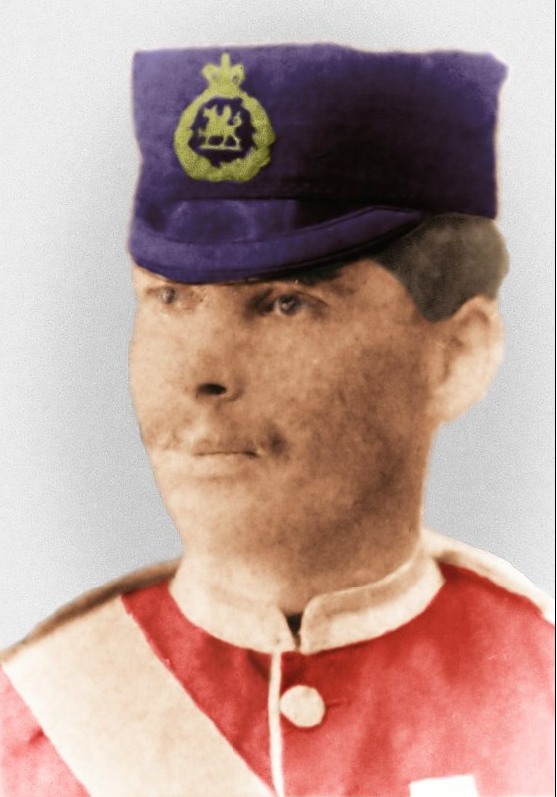
Amongst that small garrison was Sergeant Henry Gallagher, the senior Sergeant of ‘B’ Company, 2nd/24th Warwickshire Regiment of Foot.
Henry’s parents were named as Henry Gallagher, born in Ireland.
Henry Gallagher Senior was recorded as being a Merchant’s Clerk and was married to Mary Kennedy on the 7th February 1854 at Killenaule Parish Church, witnessed by James Walshe and Ellen Fitzgerald.
Henry Junior was born in about March 1855 at a place called Killenaule, County Tipperary, Ireland. He was baptised on the 28th October 1855; he had a sister although very little is known of her.
The early part of Henry’s life in Ireland is surrounded a bit in mystery. Some family stories tell that he witnessed a fire at the family home, a farm or small holding which had been reported as being claimed by the Catholic Church, for the education he had received from them upon the death of his parents.
Henry was a bright young man and quick to learn. As he grew older, Henry got employment as a Clerk and it is not certain why he chose to leave his home country of Ireland to join the British Army in Liverpool.
Enlistment and Early Service
Henry had his enlistment medical conducted by H. D. Devlin, Surgeon Major of the Army Medical Department, on the 14th March 1874. Following a second medical, he was attested at Liverpool on 16th March 1874 and joined 25th Brigade at Brecon on the 17th March 1874.
His papers show that his admitted age was 19 years 0 months. He was 5 ft 6¼ inches tall, of fresh complexion, with amber eyes and dark brown hair. His religion is noted as Roman Catholic. He was given the regimental number 25B/81.
During the following year he did his basic training and by March 1875 he had been promoted to Corporal, probably getting rapid promotion due to his education in Ireland as a young man and obtaining a 2nd Class Certificate of Army Education on the 14th December 1875.
Henry found himself in Dover and further promotion to Lance Sergeant followed in January 1877.
Henry married on the 7th April 1877 to Caroline Maria Stanley, a spinster of 6 Dover Street, Charlton, Dover, Kent. Caroline was the daughter of a North Sea Pilot who was reputedly the pilot who accompanied Captain Webb on the first ever recorded cross-Channel swim.
They eventually had six children, all three sons having careers in the Army.
South Africa and the Zulu War
June 1877 found Henry in Chatham, Kent, and a further promotion followed to Sergeant in October 1877.
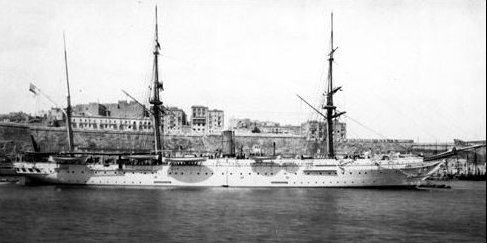
In February 1878 he was ordered to join the troopship HMS Himalaya bound for South Africa with:
- 24 Officers
- 8 Staff-Sergeants
- 38 Sergeants
- 40 Corporals
- 16 Drummers
- 750 Privates
They docked at Simon’s Bay to replenish supplies and finally reached East London, South Africa, on the 9th March. Here they were ordered onto trains that took them to King William’s Town.
Fighting, mainly skirmishing, took place in the Perie Bush during April and May with the amaXhosa in what is now known as the Last Kaffir War. During this time, the 2/24th were stationed at Mount Kempt.
Number 25B/81 Sergeant Henry Gallagher again found himself on the move and was transported by mail boat to Durban, being landed by whaler onto the beaches. He marched with the rest of the 24th Warwickshire Regiment towards Zululand, as the central column of Lord Chelmsford’s invading force.
His wife Caroline, together with other wives, remained at Pinetown, Durban.
Rorke’s Drift – January 1879
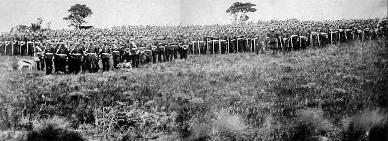
In January 1879, Henry was at Rorke’s Drift as senior Sergeant of ‘B’ Company, 2nd/24th 2nd Warwickshire Regiment.
On the morning of 22nd January, along with Colour Sergeant Bourne and three other NCOs, he was on the hill behind the Mission Station ‘The Shiyane’ (Oskarsberg). Rifle and gunfire could be heard coming from Isandlwana, and smoke and muffled battle noise were observed.
A hasty defence was constructed of mealie bags, biscuit boxes and wagons. Henry, with several other sharpshooters, was in charge of the section of mealie-bag wall on the south side between the two wagons and the hospital building. Fred Hitch was placed on the hospital roof as a lookout.
This section took the first attack of about four hundred Zulu. Henry later recalled calling out:
“Here they come as thick as grass and as black as thunder.”
He stated that the band first fired at eight hundred yards but failed to make shots count. Initially terrified, the fear soon left him during the fighting, only to return after the battle.
The continuous firing caused rifle barrels to glow red. Henry tore the sleeve from his tunic to wrap around the barrel to prevent burning his hands. Powder flashback tattooed the right side of his face, leaving a permanent blue-black mark.

Later Service Overseas
Later in 1879, Henry was moved to Utrecht and took no further part in the Anglo-Zulu conflict. In January 1880, he joined HMS Orontes bound for Gibraltar, serving 294 days before returning to home service.
In January 1881, he was promoted to Colour Sergeant. His first child, Caroline Lillian, was born at Brecon on 17th August 1881.
Following the Cardwell Reforms, the regiment became the 2nd Battalion South Wales Borderers, and Henry was given a new regimental number: SWB/1590.
For service in South Africa he received the South Africa Campaign Medal with clasp 1877–8–9.
India, Burma, Aden, and Egypt
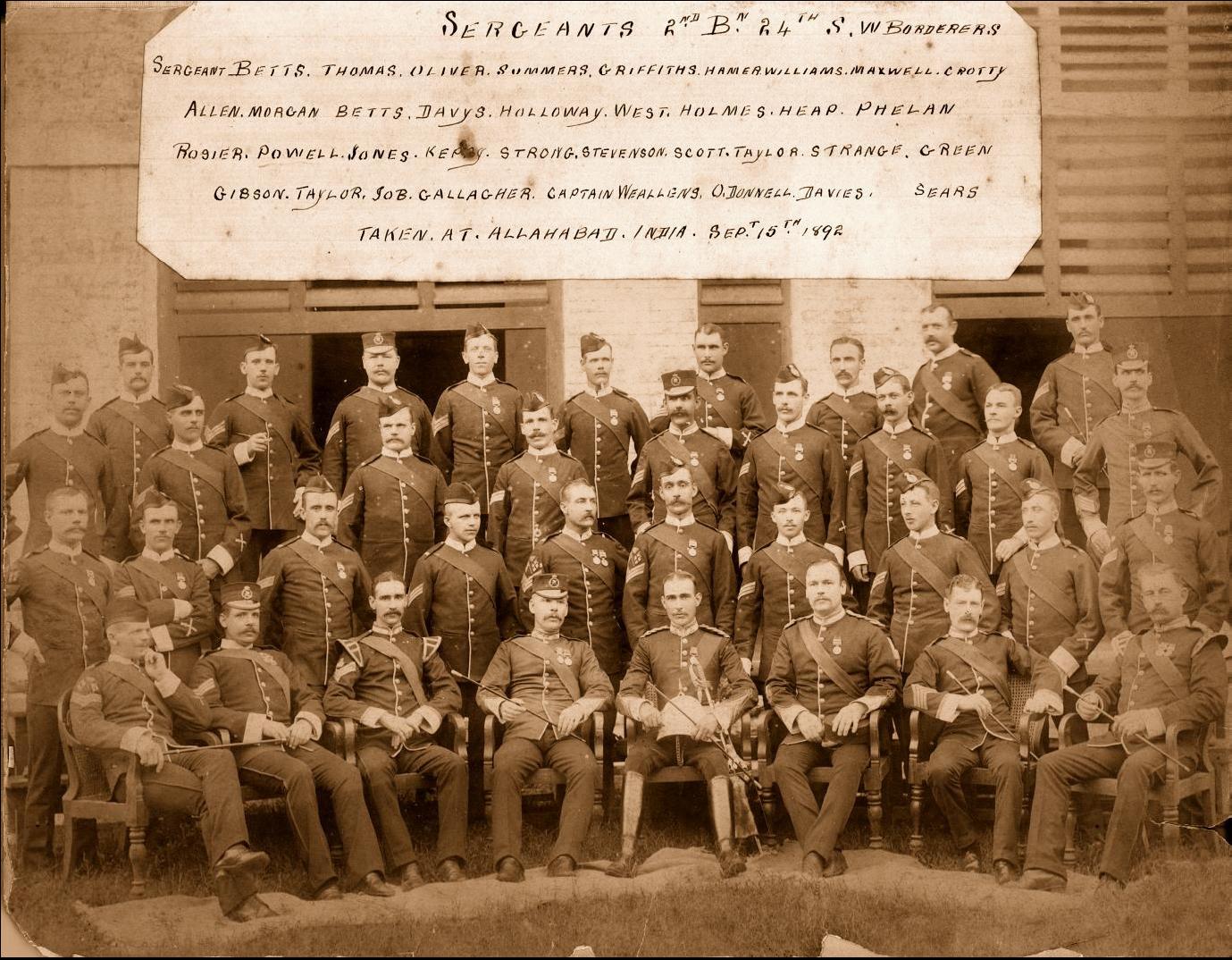
In January 1883, Henry and his family departed for India. His son Henry Edward was born in Secunderabad on 17th June 1883, later serving in the Royal Engineers.
Further postings followed:
- Madras – son William Alfred, born 13 October 1885
- Burma – daughter Violet Elizabeth, born 29 January 1888
- Awarded India General Service Medal with clasp Burma 1887–89
He returned to India, and on 9 January 1889 was promoted to Sergeant Major (Warrant Officer). Daisy Dorothea was born at Ranikhet in February 1890.
In October 1892, he was posted to Aden aboard HMS Serapis. He was hospitalised briefly with ulcers of the feet.
In Egypt, Henry served as Garrison Sergeant Major in Cairo, a role equivalent to modern Regimental Sergeant Major.
Retirement and Final Years
Henry returned to Britain on 31 March 1897 and was discharged on 10 May 1897, after 23 years and 56 days service. Almost immediately he was appointed Barrack Warden at Hilsea and Alexandria Hospital, remaining until 1911.
He was awarded the Meritorious Service Medal on 29 November 1910.
In retirement, he lived at “Wistaria,” Augustin Road, Drayton, Hampshire, enjoying gardening and poultry keeping. Fred Hitch VC often visited, though grandchildren were ordered away during their conversations.
On anniversaries of Rorke’s Drift, Henry became withdrawn and reflective.
Death and Burial
On 17 December 1931, Henry died of a heart condition at the age of 75, his occupation recorded as Warrant Officer, Army Pensioner.
He was buried at Christ Church, Portsdown, with semi-military honours. Wreaths were laid by former comrades of ‘B’ Company, including representatives of the South Wales Borderers.
His wife Caroline died shortly afterwards and is buried with him.
25 August 2003
Roger Lane (Great-Grandson)
© Copyright 2003 Roger Lane