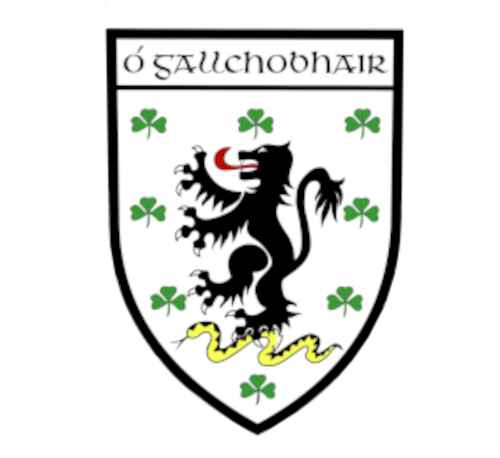
The Ancient Origins of the Gallagher Clan
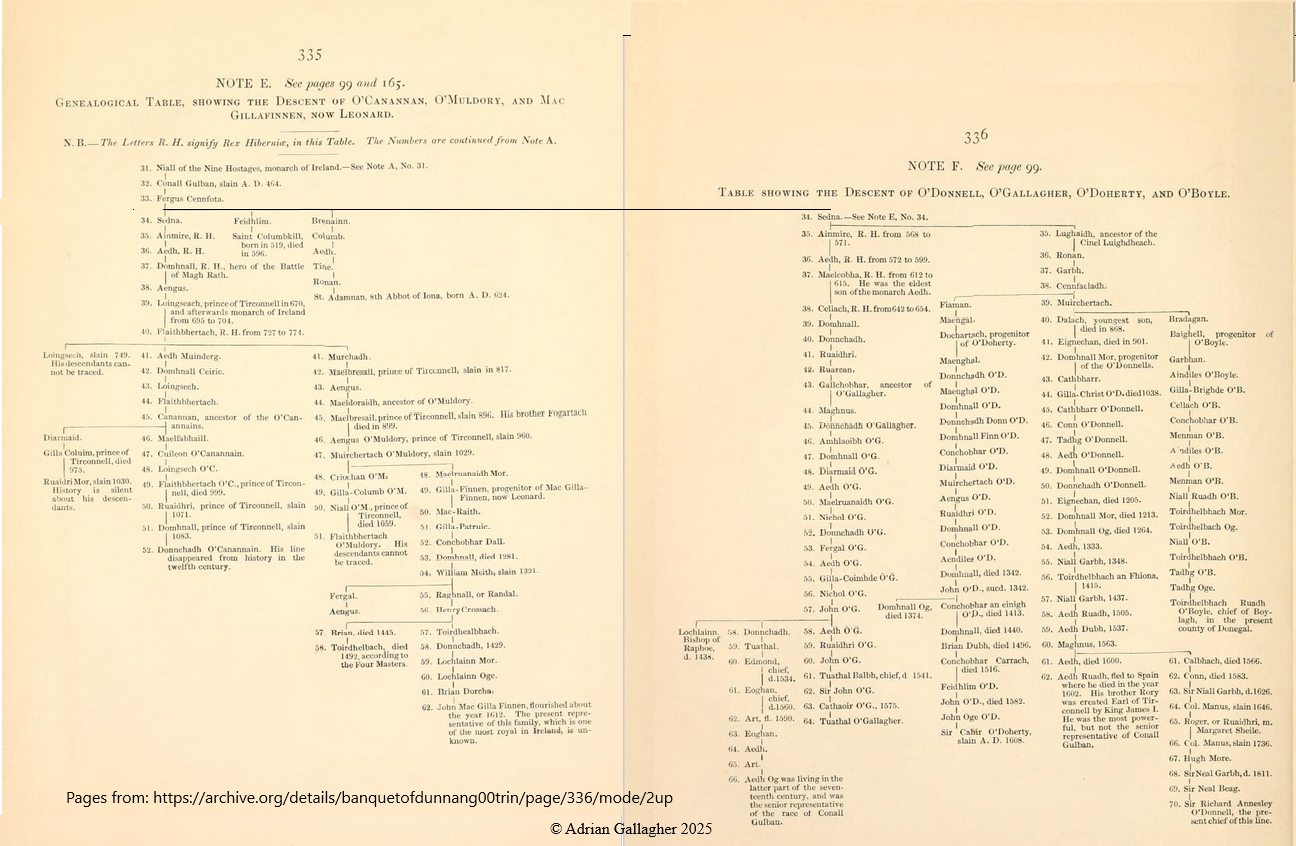
“…“Clann” means family grouping in the Gaelic language. The Gallaghers can trace their family roots back to the early centuries A.D.. “The O’Gallaghers are the senior and most royal family of all the Kinel-Connell (the ancient rulers of what is today the greater part of Co. Donegal, Ireland)i.”
— John O’Donovan, nineteenth-century Irish historian
John O’Donovan, one of the great Irish historians of the nineteenth century, based this belief on his extensive study of the old Irish genealogies. These genealogies had been passed down orally, from generation to generation over centuries, and were written down for posterity in the seventeenth century by scholars who feared the possible end of the Gaelic tradition.
For further background, see John O’Donovan’s Gallagher Lineage Research.
Early Manuscript Evidence
In a fragment of an earlier manuscript now held in the Royal Library of Brussels (MS 3410), we are introduced to the “muintir Ghallchubair” — the Gallaghers, as we call ourselves today.
This text belongs to the Middle Irish period, dating from circa 1050–1150.
Manuscript Reference
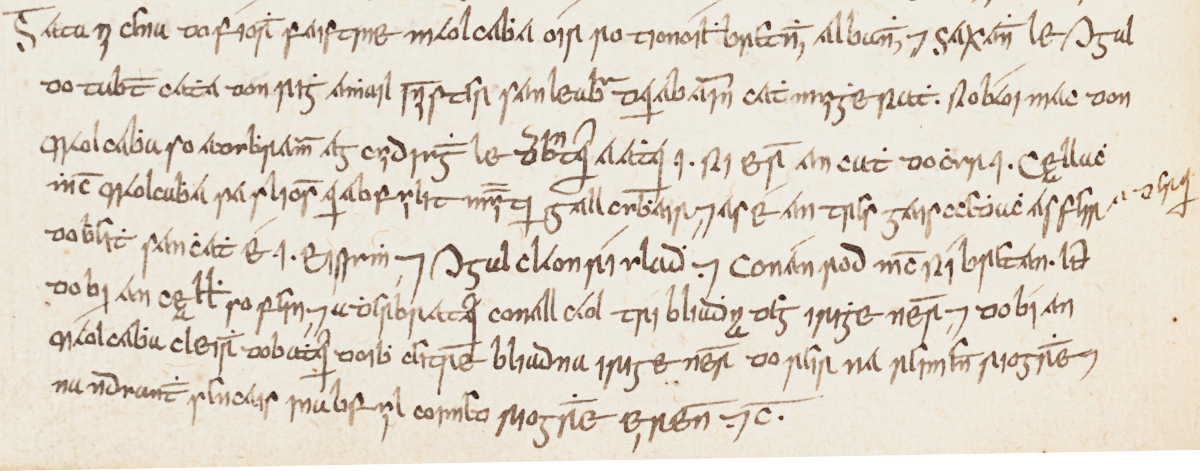
Original Gaelic text:
202] Gacha ní chena do fíoradh fáistine Máol Cabha, óir
203] ro tionóiledh Bretnaigh, Albanaigh, & Saxanaigh le
204] Congal do thabairt catha don rígh amhail innister 'san
205] leabar darab ainm Cath Muighe Rath. Ro baoí mac don
206] Máol Cabha so adubhramar ag cuidiugadh le derbráthair
207] a athar .i. rí Érenn an cath do chur .i. Ceallach mhac
208] Máol Cabha 'sa shliocht ara bfuilit muinntir Gallchubhair,
209] & as é an tres gaisccedhach as ferr aderar do bheith 'san
210] chath é .i. ei-siumh & Congal Cláon rí Uladh & Conán
211] Rod mac Rí Bretan. Ocus do bí an Ceallach so féin & a
212] dherbráthair Conall Cáol trí blíadhna dég i ríghe n-Érenn,
213] & do bí an Máol Cabha cléirech dob' athair dóibh ceithre
214] blíadna i ríge n-Érenn do réir na réimenn ríograidhe & na
215] n-dúantadh senchais ina bfuil coiméd ríograidhe Éirenn &c
Translation (Extract)
205–208
“…For there was a son of Máol Cabha that we have mentioned, helping the brother of his father, i.e., king of Ireland, to do battle, namely Ceallach, son of Máol Cabha, from whose line are the descendants of Gallchubhair.”
Lineage and Meaning of the Name
Our line can thus be traced back to Niall of the Nine Hostages, who is reputed to have brought St Patrick to Ireland as a slave.
The family tree then ascends through successive High Kings of Ireland to the man known as Gallchobhair, living around the 8th–9th centuries.
One possible interpretation of the name Gallchobhair is “Helper of the Foreigner”. Whether this referred to strangers from other parts of Ireland, or — as some suggest — to Norsemen attacking the coast, cannot be stated with certainty.
Status in Medieval Donegal
What is known is that the O’Gallchobhair (descendants of Gallchobhair) were accepted as one of the high-born families of the Donegal region, with blood ties to most of the ruling families of the area.
They were entitled to take part in the inauguration of the Chief of Tír Chonaill, later the O’Donnell, and their horsemen formed the backbone of the O’Donnell cavalry.
Ecclesiastical Influence
Gallaghers were even more strongly represented in ecclesiastical life, supplying numerous bishops and abbots to the Church.
Gallagher families also held hereditary stewardships of church lands until English control was imposed in Donegal at the start of the seventeenth century.
Geographic Origins
The Clan was originally based in what is today County Donegal, formerly known as Tír Chonaill, located in the northwest of Ireland.
One group was found in the south of the county, adjacent to what is now Donegal Town. While the name is generally translated as “the fort of the stranger”, it may equally be interpreted as “the fort of the Gallaghers”. The absence of “-chobhair” can be explained by the natural tendency to shorten words in both Gaelic and English.
Their principal strongholds lay in the baronies of:
- Banagh (south-west Donegal)
- Raphoe (east Donegal)
- Tír Hugh (south Donegal)
War, Displacement, and Migration
Following the defeat of Irish forces by the English at the start of the seventeenth century, native inhabitants were forced from their lands.
Many Gallaghers were driven west into poorer lands in Donegal and Mayo, while others may have followed Rory O’Donnell of Lifford into Mayo, possibly during the Cromwellian transplantation (c.1654) — though this remains unverified.
As the military arm of the O’Donnells, many Gallaghers fought in the Nine Years’ War, culminating in the Battle of Kinsale (1603). During these conflicts, some were inevitably displaced from their home territories.
Family tradition in at least one Cork family records their Gallaghers as “coming down to Kinsale with O’Donnell.” This is supported by Griffith’s Primary Valuation, which shows County Cork (58 households) as having the highest concentration of Gallaghers outside the north-western counties.
Over time, large Gallagher populations also emerged in counties adjoining Donegal:
- Derry
- Tyrone
- Fermanagh
- Leitrim
- Sligo
- Mayo
Worldwide Diaspora
Through the centuries, for many reasons, the Irish have emigrated — and the Gallaghers were no exception.
Today, large numbers of the Clan are found in:
- England, Scotland, and Wales
- The United States
- Canada
- Australia
- New Zealand
Indeed, there are few countries on Earth that have not had members of the Clan leave their mark in one way or another.
A Living Legacy
In earlier times, members of the Clan were renowned as church leaders and warriors. Today, Gallaghers can be found in all walks of life, across the globe.
It is our hope to gather these family stories together and preserve them for generations to come.