The Donegal Relief Fund
Emigration to Australia
An article from the Donegal Democrat, September 1991
Early Irish Emigration to Australia
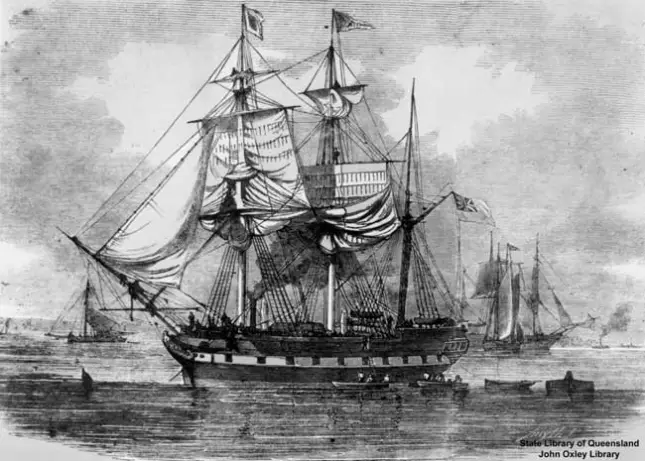
Emigrant ship, mid-19th century Credit: https://www.slq.qld.gov.au/
Emigration from Donegal to Australia in the nineteenth century — and particularly the large-scale emigration from the west of the county — was examined by Dr Richard Reid, a native of Portrush and lecturer in History at the University of Canberra, in a lecture delivered at Glenveagh National Park. The event was organised by An Taisce.
Dr Reid explained that the Irish had been present in Australia from the very beginnings of migration and formed strong communities throughout the country. He noted that the Irish experience of emigration to Australia differed greatly from that of those who travelled to North America, largely because emigrants to Australia were predominantly Government-Assisted Emigrants, with their passage paid for.
Conditions on the Voyage
Even convicts transported to Australia in the 1830s experienced conditions superior to those endured by people crossing the North Atlantic, despite the journey to Australia being three times longer.
This was due to the demand for healthy agricultural labourers. Ships travelling to Australia carried:
- A qualified surgeon
- Regulated berthing space
- A carefully planned diet
- Mandatory hygiene routines, including washing decks, clothes, and berths
As a result, the death rate on Australian-bound ships in the 1820s and 1830s was very low, in stark contrast to the high mortality rates on Atlantic crossings during the same period.
The same level of care continued for Assisted Emigrants from the 1840s until the end of the century. Only one in ten Irish emigrants to Australia during the nineteenth century were convicts.
Assisted Passage Requirements
To qualify for an Assisted Passage, emigrants had to:
- Pass a medical examination
- Complete official forms
- Obtain signatures from a magistrate, doctor, and parish priest or Church of Ireland rector
- Submit documentation to London
Emigrants were required to report to Plymouth or Birkenhead one week prior to departure for inspection. Although passage was assisted, individuals still needed funds to purchase a sea chest and pay for travel to England.
Order, Education, and Community
Whereas travel to North America was often chaotic, Australian emigration was tightly organised. Boarding cards were required, and efforts were made to berth emigrants from the same parish together, providing comfort on voyages lasting several months.
A ship’s surgeon oversaw both health and moral welfare, and where possible, a schoolmaster was appointed. There is evidence that some emigrants arrived in Australia literate, having learned to read and write during the voyage.
Dr Reid noted that the Irish-Australian Society was founded by Free Emigrants, not figures such as Ned Kelly.
Gender Balance and Employment
Initially, four out of five emigrants were male, leading to social imbalance. To correct this, the Government sought equilibrium, and during the Gold Rush of the early 1850s, five out of six assisted Irish emigrants arriving in Sydney were female.
On arrival:
- Single women were housed in barracks
- Employers hired through regulated systems
- Contracts were legally binding
- Authorities intervened if problems arose
Dr Reid concluded that Irish emigrants to Australia carried sadness but not bitterness, contributing to a more settled Irish identity than that found in North America. Most emigrants originated from Clare, Tipperary, and Fermanagh.
Donegal and the Relief Fund
“600 From One Parish”
Donegal emigration became significant around 1859, reaching its peak between 1859 and 1863. An extraordinary 90% of Donegal emigrants came from the north-west coast.
In 1859, no fewer than 600 people from Tullaghbegley parish emigrated to New South Wales — an unmatched figure in the history of Assisted Migration.
The Appeal from Donegal (1858)
In 1858, local priests published an appeal in the Freeman’s Journal, describing appalling conditions in Gweedore and Cloughaneely:
“Countrymen, and Fellow Christians… thousands upon thousands of human beings… are perishing or next to perishing amid squalidness and misery…”
They described bleak terrain, poverty, and communities subsisting on marginal land and stock grazing.
The Sheep Tax and the Response
Following sheep killings in Gweedore, a Sheep Tax was imposed to compensate landowners. Police were stationed to collect it, pushing already impoverished communities further into hardship.
The priests established the Gweedore Relief Committee, seeking aid in kind. However, the Irish community in New South Wales responded differently. Believing that sending money would only reinforce landlord systems, they instead raised funds to assist emigration.
Thousands of pounds were collected to subsidise passages. Archdeacon John McEnroe, originally from Tipperary, became president of the Donegal Relief Committee in New South Wales and was instrumental in mobilising support.
Small Donegal Relief Committees emerged across the colony. A selector was sent from Australia to choose emigrants, ensuring Government approval.
(Further material was intended for publication but never made it to print.)
Rae Luckie Crosses the Bridge of Tears
The Circle Is Complete (2008)
Some 150 years later, an email arrived from Australia. Rae Luckie, great-granddaughter of Maggie (Madgy) Gallagher, sought to retrace her ancestor’s journey back to Donegal.
With only Cloughaneely as a clue, Rae was put in touch with Lindel Buckley of the Donegal Resources website. Tulloghbegley was identified as the most likely home parish.
Returning to Donegal
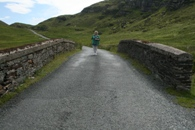
In July 2008, Rae returned to Donegal, entering Cloughaneely via Droichead na nDeor — the Bridge of Tears.
Historically, families accompanied emigrants this far before parting, often forever. Emigration to distant lands like Australia was usually one-way, and many tears were shed on the bridge.
Rae, the first known descendant to return, felt deeply the sadness her great-grandmother must have known.
Completing the Journey
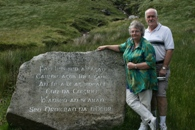
Rae and her husband Barry continued to Tulloghbegley, where, although unable to pinpoint Maggie’s home, they walked the townland, breathed the Atlantic air, and looked toward Tory Island, knowing that the circle was complete.
During their visit, they met Lindel Buckley, who was then researching in Donegal. That evening, Lindel was presented with a Gallagher Plate by Adrian Gallagher on behalf of the Clan, in recognition of her invaluable assistance.
Continuing the Story
Another descendant of Donegal Relief Fund emigrants later made contact. Records traced their ancestor to Devlin, allowing relatives to be identified. In August 2009, this descendant also returned to Donegal — a journey shorter in distance, but vast in time since their ancestor left in fear and hope.
——————————————————————————–
Further similar stories:
FROM THE BRIDGE OF TEARS TO AUSTRALIA AND BACK, VISITING MY PAST by Joy McGuire see HERE
FERRY and GALLAGHER – PART OF THE DONEGAL RELIEF FUND STORY by Collen Wright see HERE